Research is one of the jobs where AI saves the most time, and where mistakes cost the most. The best AI research tools help you find sources, read long papers and check claims, while showing you exactly where each answer comes from. This guide is part of our full list of the best AI tools.
Free plans and prices were last checked in October 2026.
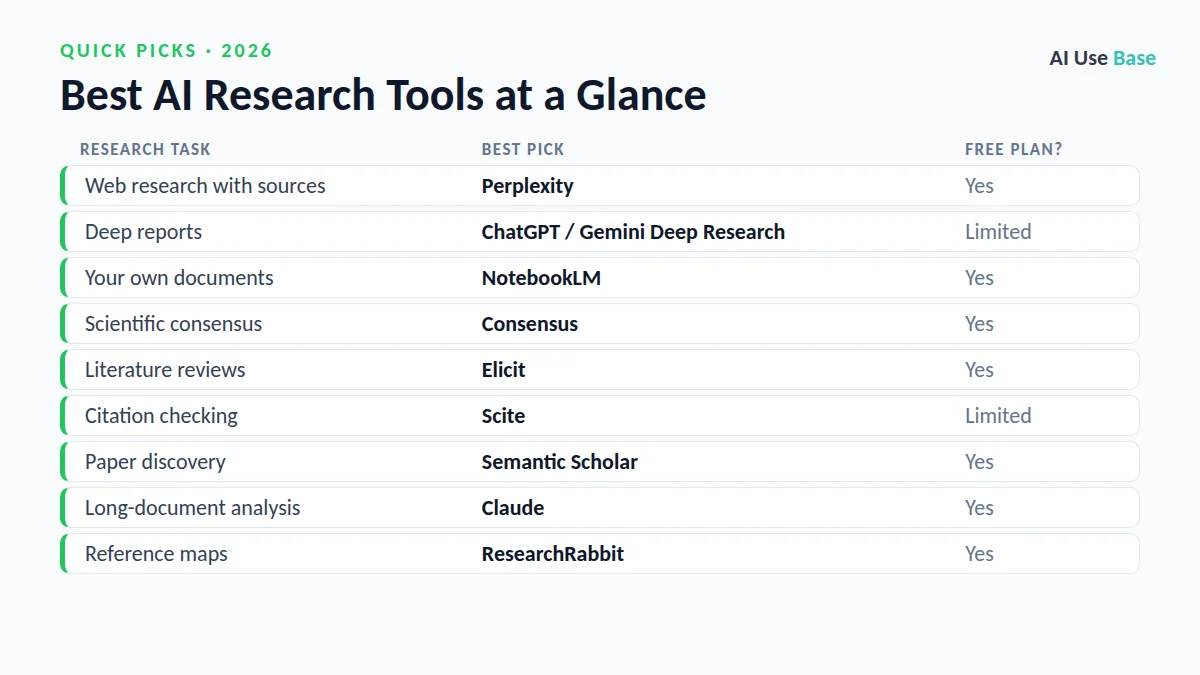
Quick Picks: The Best AI Research Tools at a Glance
| Research task | Best pick | Free plan? |
|---|---|---|
| Web research with sources | Perplexity | Yes |
| Deep reports | ChatGPT / Gemini Deep Research | Limited |
| Your own documents | NotebookLM | Yes |
| Scientific consensus | Consensus | Yes |
| Literature reviews | Elicit | Yes |
| Citation checking | Scite | Limited |
| Paper discovery | Semantic Scholar | Yes |
| Long-document analysis | Claude | Yes |
| Reference maps | ResearchRabbit | Yes |
How We Chose the Best AI Research Tools
We picked tools that solve a real, repeated task, are actively maintained, offer a usable free plan or fair price, and clearly lead their category. Prices are US starting prices for individual plans, last checked in October 2026, and can change, so always confirm on the official site.
What Makes the Best AI Research Tools?
The best AI research tools are judged on trust, not just speed:
- Citations: every claim links to a source you can open.
- Source quality: access to reputable or peer-reviewed sources.
- Grounding: answers stick to the documents you provide.
- Transparency: clear limits on what the tool does not know.
Chatbots that answer without sources did not make this list of the best AI research tools.
Best AI Research Tools for General Research
These are the best AI research tools for everyday questions, market research and reports.
1. Perplexity – Best AI search engine with citations
Perplexity answers questions with numbered sources and is ideal for current events, market research and quick fact-finding.
- Free plan: Yes, limited Pro searches
- Paid: Pro about $20/month
- Website: www.perplexity.ai
2. ChatGPT and Gemini Deep Research – Best for multi-source reports
Deep Research in ChatGPT and Gemini browses many websites and writes a structured report with citations, saving hours of manual searching.
- Free plan: Limited reports
- Paid: More reports on ChatGPT Plus and Google AI Pro
- Website: chatgpt.com
3. NotebookLM – Best for researching your own sources
NotebookLM answers only from the documents you upload, with citations to the exact passage, and can create study guides and audio overviews.
- Free plan: Yes
- Paid: Higher limits with Google AI plans
- Website: notebooklm.google
4. Claude – Best for analyzing long documents
Claude reads long reports and papers carefully and produces clear summaries and comparisons, which is useful for policy and business research.
- Free plan: Yes
- Paid: Pro $20/month
- Website: claude.ai
Best AI Research Tools for Academic Work
Academic research needs peer-reviewed sources. These are the best AI research tools for papers and literature reviews.
5. Consensus – Best for scientific consensus
Consensus searches peer-reviewed papers and shows whether studies agree, which is helpful for evidence-based questions.
- Free plan: Yes, limited Pro features
- Paid: About $20/month
- Website: consensus.app
6. Elicit – Best for systematic literature reviews
Elicit finds relevant papers, extracts key data into tables and helps structure literature reviews.
- Free plan: Yes
- Paid: From about $49/month
- Website: elicit.com
7. Scite – Best for checking citations
Scite shows how a paper has been cited, including whether later studies support or contradict it.
- Free plan: Limited
- Paid: From about $10/month
- Website: scite.ai
8. Semantic Scholar – Best free paper search
Semantic Scholar is a free AI-powered search engine for scientific literature with paper summaries and citation data.
- Free plan: Free
- Website: www.semanticscholar.org
9. ResearchRabbit – Best for mapping related papers
ResearchRabbit builds visual maps of related papers and authors, helping you discover work you might otherwise miss.
- Free plan: Yes
- Website: www.researchrabbit.ai
How to Use AI Research Tools Responsibly
- Start broad with Perplexity or Deep Research.
- Switch to academic tools such as Consensus or Elicit for scholarly work.
- Upload key sources to NotebookLM for grounded answers.
- Open and read the original sources before you cite anything.
- Follow your institution’s AI rules for assignments and publications.
New to Perplexity? Our beginner guide on how to use Perplexity covers search modes, follow-up questions and checking sources.
Frequently Asked Questions
What is the best AI research tool?
Perplexity is the best AI research tool for general research with sources, NotebookLM is best for your own documents, and Elicit and Consensus are best for academic papers.
Are AI research tools accurate?
They are helpful but not perfect. AI tools can misread or invent details, so always open the cited sources and verify important claims.
What are the best free AI research tools?
Perplexity, NotebookLM, Semantic Scholar, ResearchRabbit, Consensus and Elicit all offer free access, and Claude, ChatGPT and Gemini have free plans.
Can I use AI for a literature review?
Yes, tools like Elicit, Consensus and ResearchRabbit speed up finding and summarizing papers, but you still need to read key papers and follow your institution’s rules.
Final Thoughts
The best AI research tools make finding and reading sources dramatically faster, but the responsibility for accuracy stays with you. Combine a search tool, a document tool and an academic tool, and always verify before you cite.
Want the bigger picture? See our complete guide to the best AI tools for every use case, or read our guides on best AI tools for students and AI PDF reader.