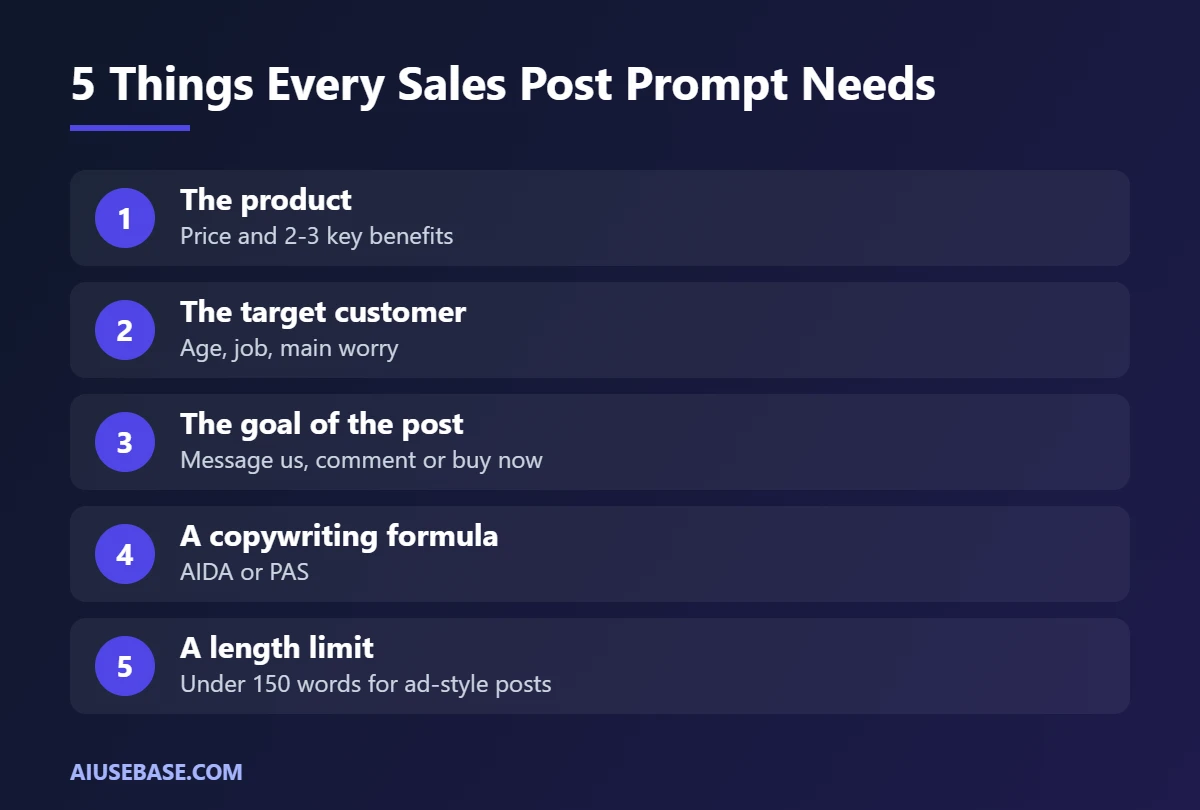
A good ChatGPT prompt for Facebook sales posts includes 5 things: the product (price and key benefits), the target customer, the goal of the post (message us, comment, buy now), a copywriting formula (AIDA or PAS) and a length limit. Below are 23 copy-and-paste prompts for every common selling situation. Replace the parts in brackets and they work in ChatGPT, Gemini or Claude.
Last updated: September 27, 2026.
Step 0: Create a Reusable Shop Brief
Before using the prompts below, paste this at the start of your chat, or save it in Projects (ChatGPT) or a Gem (Gemini) so you never retype it:
I sell [product type] on Facebook. Main customers: [age, gender, job, common worries]. Tone: [friendly, casual], moderate emoji use. Avoid hype words like “best ever”, “#1” or “100% guaranteed”. Policies: [shipping, returns, warranty]. Remember this for all future posts.
Prompts for Product Introductions and Launches
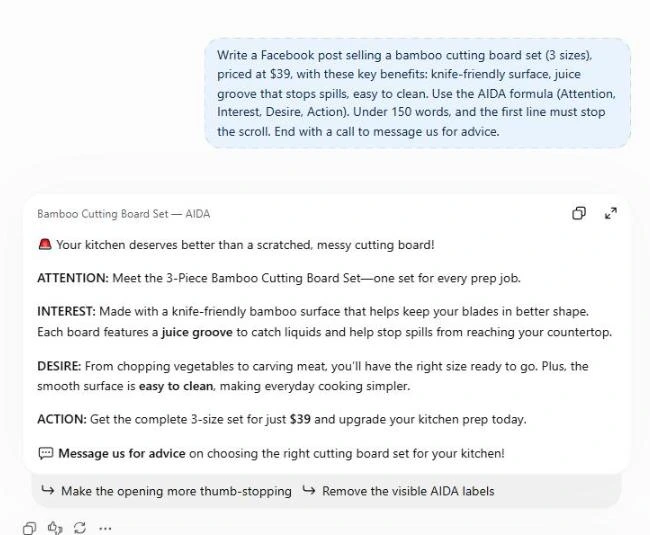
1. Product post using AIDA
Write a Facebook post selling [product], priced at [price], with these key benefits: [3 benefits]. Use the AIDA formula (Attention, Interest, Desire, Action). Under 150 words, and the first line must stop the scroll. End with a call to message us for advice.
2. Post using PAS (Problem, Agitate, Solution)
Write a Facebook post using the PAS formula for [product], which solves [customer problem]. Make the agitation specific and relatable, not fear-based. Under 150 words, with 3 bullet-point benefits.
3. New product launch
Write a series of 3 Facebook posts to launch [new product]: post 1 teases without revealing the product, post 2 reveals and introduces it, post 3 opens sales with [offer] for the first 50 buyers. Each under 100 words.
4. Ad variations for testing
Write 5 Facebook ad variations for [product], each from a different angle: value, quality, convenience, gifting, emotion. Each under 80 words with a headline under 40 characters. Present as a table.
Prompts for Promotions and Closing Sales
5. Flash sale
Write a Facebook post announcing a flash sale on [product]: [x]% off from [time] to [time] on [date]. Create urgency honestly, without inventing stock numbers. Include the original price, the sale price and how to order. Under 100 words.
6. Bundle offer
Write a post introducing a bundle of [product A + product B] for [bundle price] (separately [total price]). Explain why they work well together and how much the customer saves. Under 120 words.
7. Holidays and events
Write 3 Facebook posts selling [product] for [Mother’s Day, Black Friday, Christmas], positioning it as a gift for [recipient]. Each under 100 words with a greeting that fits the occasion.
8. Live selling script
Write a 20-minute Facebook Live selling script for [product]: a hook to keep viewers, 3 key features, answers to 5 common questions, an engagement mini-game, and a close with a live-only offer. Break it down by timestamp.
Prompts for Engagement and Trust
9. Customer testimonial post
Using the real customer feedback below, write a Facebook post sharing it. Keep the customer’s meaning, add a thank-you and a light product mention. Do not add details the customer did not say.
Feedback: [paste real feedback]
10. FAQ post
List 7 questions customers often ask before buying [product] and write a short answer for each, based on: [specs, policies]. Format it as a “Quick Q&A” Facebook post.
11. Brand story post
Write a Facebook post telling the story of why we started selling [product], based on: [your real story]. Sincere tone, 150-200 words, ending with a question that invites comments.
12. Engagement posts
Give me 5 engagement post ideas for a page selling [product], such as this-or-that questions, guess the price, or fill in the blank. Write each as a complete post under 50 words.
Prompts for Customer Care
13. Replying to a negative comment
A customer commented: “[comment]”. Write 2 public reply options: polite, taking responsibility if we were at fault, and inviting them to message us to resolve it privately. Under 50 words each.
14. Re-engaging past customers
Write a Messenger message to customers who bought [product] [time] ago, asking about their experience and introducing [new product or offer] for returning customers. Under 60 words, not spammy.
15. Improving an old post
Here is one of my old posts and its results: [reach, engagement, messages]. Analyze why it underperformed, then write 2 better versions and explain what you changed.
Tips for Sales Posts That Actually Convert
- Always give real information: price, specs, policies and genuine feedback. ChatGPT does not know your product and may make things up.
- Demand a strong opening line: the first 1-2 lines decide whether people tap “See more”.
- Trim excess emoji and hashtags if ChatGPT overdoes them.
- Never exaggerate benefits, especially for cosmetics and supplements. False claims can breach advertising rules and Meta’s ad policies.
- Pair copy with good visuals: see the best free AI background removers for clean product shots.
Not sure whether ChatGPT or Claude writes better copy? Read ChatGPT vs Claude for writing.
ChatGPT Prompts for Facebook Ads
Ads need a different style from normal posts: a strong first line, one clear offer and one call to action. Add your shop brief from Step 0 first, then use these prompts.
- “Write 5 Facebook ad primary texts for [product]. Each must start with a hook under 10 words, mention one main benefit and end with [call to action]. Keep each under 125 characters.”
- “Give me 10 Facebook ad headlines under 40 characters for [offer]. Mix benefit, curiosity and urgency styles.”
- “Write 3 ad versions for [product] aimed at three different audiences: [audience 1], [audience 2], [audience 3]. Change the pain point and wording for each.”
- “Create a problem–agitate–solution ad for [product]. Keep it honest and under 90 words.”
- “Write a retargeting ad for people who visited [product page] but did not buy. Address the most likely objection: [price/shipping/trust].”
- “Turn this customer review into ad copy without changing its meaning: [paste a real review, with permission].”
- “Suggest 5 image or short video ideas for a Facebook ad about [product] that would work with this text: [paste text].”
- “Check this ad for anything that could break Facebook advertising rules, such as exaggerated claims, before-and-after promises or personal attributes. Suggest safer wording: [paste ad].”
Test two or three versions at a small budget before scaling, and keep the winner’s hook for future ads. For a wider view of marketing tools, read our guide to AI for marketing and our list of AI tools for small business.
Hands-On Test: Facebook Ad Prompt #1 in ChatGPT Free
We ran the first Facebook ad prompt from this guide in the free version of ChatGPT on October 18, 2026, for a made-up neighborhood bakery offering 20% off croissants for one weekend.
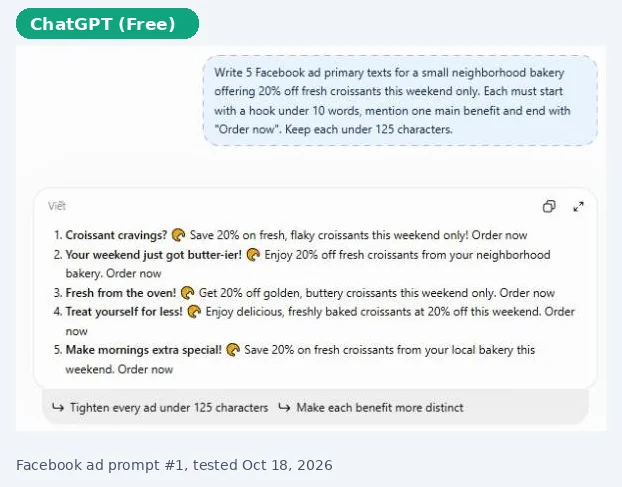
- Rules followed: all five ads started with a short hook, ended with “Order now” and stayed under 125 characters (86 to 107 characters each).
- Too similar: every ad used the same emoji and repeated the same benefit, 20% off fresh croissants. ChatGPT itself suggested a follow-up to “make each benefit more distinct.”
- Easy fix: ask for five different angles, for example “taste, convenience, a weekend treat, a gift for coworkers and supporting a local business,” and you get far more variety to A/B test.
Lesson: AI follows format rules well but defaults to safe, repetitive copy. Always ask for distinct angles and test at least two versions before you spend money. For more ideas, see our guide to AI for marketing.
Frequently Asked Questions
Do these prompts work in Gemini and Claude?
Yes. All 23 prompts work in Gemini and Claude. Each assistant has a slightly different voice, so test them and pick the one that fits your brand.
How long should a Facebook sales post be?
Ad-style posts work best under 150 words with a gripping first line. Brand stories or FAQ posts can run 200-300 words if the content is genuinely useful.
Does Facebook restrict AI-written posts?
Facebook does not ban AI-written content, but posts must still follow Community Standards and advertising policies: no false claims, no exaggerated benefits and no misleading images.
How do I get ChatGPT to write in my brand voice?
Paste 3-5 of your best-performing posts and ask ChatGPT to analyze the voice, then save that analysis in your shop brief, Projects or custom instructions.
Should I let ChatGPT reply to customers automatically?
Use ChatGPT to draft reply templates, but have a person review messages before they go out, especially for complaints, returns and pricing.
Final Thoughts
These 23 ChatGPT prompts for Facebook sales posts cover nearly every situation an online shop faces, from launches to customer care. Write your shop brief once, fill in real details for each prompt, and always proofread before posting. For the full workflow, see our AI for marketing guide.
Looking for more step-by-step tutorials? Browse our AI Guides.