English shadowing is one of the fastest ways to sound more natural when you speak. You listen to a sentence and say it straight back, copying the speaker’s rhythm, stress and intonation. The hard part used to be finding audio that matched what you actually wanted to practise. Now AI text-to-speech can read any text aloud, so you can shadow your own exam answers, work presentations or any passage you like.
Below is a free English shadowing tool that runs right in your browser. Paste your text, press play and repeat each sentence in the pause. In Chrome and Edge you can also press the microphone button to check your pronunciation word by word. No sign-up and no app to install.
Free English Shadowing Tool
Paste any English text, listen sentence by sentence, repeat in the pause, then check your pronunciation with the microphone.
Step 1 · Your text
Step 2 · Settings
Tip: for the most natural exam-style voices, open this page in Microsoft Edge (Natural voices) or Chrome (Google UK English). The voice already plays at 100% volume, so use your device volume to go louder.
Step 3 · Listen, repeat and check
Tip: press 🎤 on a sentence, say it aloud, and the tool shows which words it heard correctly (works in Chrome and Edge).
- Load a text above and your sentences will appear here.
What is English shadowing?
Shadowing means repeating what a speaker says almost at the same time as you hear it, like a shadow that follows you. The technique was popularised by language teachers and polyglots, and it is now widely used for interpreting training and exam preparation. Unlike reading aloud, shadowing forces you to copy how English really sounds: the linked words, the reduced vowels and the rise and fall of each sentence.
There are two main ways to do it. In listen and repeat, you hear a sentence, then say it in a short pause. In real-time shadowing, you speak along with the audio, just a fraction of a second behind. The tool above supports both modes.
Why the English shadowing technique works
- It trains your ear and mouth together. You can’t repeat a sentence well until you have really heard it, so listening improves at the same time as speaking.
- It builds natural rhythm. English is a stress-timed language. Copying a model sentence teaches you which words to stress and which to shorten.
- It reduces translation in your head. Repeating whole chunks at speed helps you store useful phrases, not single words.
- It builds confidence. Saying correct, fluent sentences out loud many times makes speaking feel less stressful in real conversations and tests.
How to use this free English shadowing tool
- Paste your text. Use a paragraph from a book, an exam answer, a news article or a script you created with AI. You can also try one of the four sample texts.
- Press Load text. The tool splits the text into sentences. Very long sentences are split at commas so they are easier to repeat.
- Choose a voice and speed. Pick a UK or US voice, female or male, like the speakers in exams such as Aptis and IELTS. Start at 0.8x to 0.9x, then move to 1.0x when the text feels comfortable.
- Choose a mode. Listen and repeat leaves a pause after each sentence (you can make it longer or shorter). Shadow plays sentences back to back so you speak along.
- Press Play all, or tap a single sentence. The current word is highlighted as the voice reads it.
- Check yourself with the microphone. Press the 🎤 button on a sentence and say it. The tool shows the words it heard correctly in green, missed words in red, and a match score.
- Hide the text when you are ready. Tick Hide text to practise by ear only, and press 👁 if you need a quick look.
Your text and settings are saved in your browser, so you can come back tomorrow and continue. Nothing is uploaded to our server.
The 4-stage English shadowing method
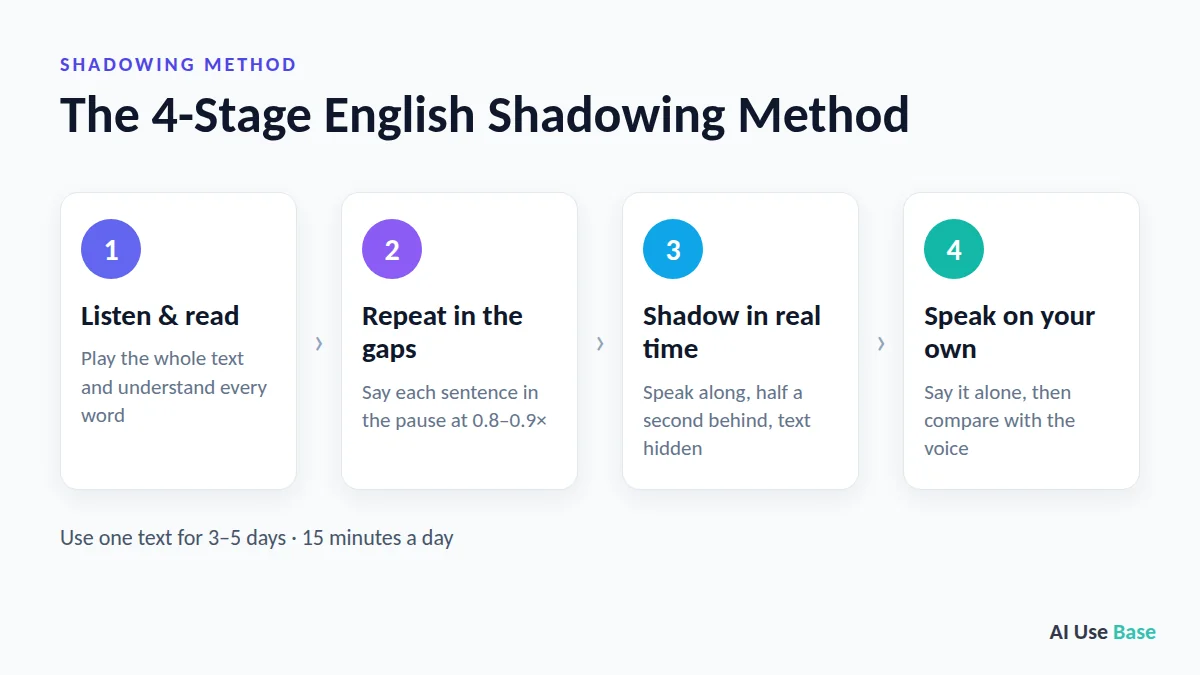
Don’t try to shadow a new text at full speed straight away. Good English shadowing practice moves from understanding to speaking freely. Move through these four stages over a few days.
Stage 1: Listen and read
Play the whole text once while reading along. Tap any sentence you don’t understand and check new words. The goal is to understand everything before you start speaking.
Stage 2: Repeat in the gaps
Use Listen and repeat mode at 0.8x to 0.9x. Say each sentence in the pause, copying the stress and intonation, not just the words. Use the microphone check on sentences that feel difficult.
Stage 3: Shadow in real time
Switch to Shadow mode and speak along with the voice, about half a second behind. Turn on Hide text once you can follow without reading. If you lose track, stop and replay that sentence.
Stage 4: Speak on your own
Turn the audio off and say the whole passage alone. Then play the tool’s version and compare. Listen for missing word stress, flat intonation or sounds you dropped, and repeat stage 3 for those sentences.
Use AI to create shadowing scripts at your level
The best shadowing material is slightly above your current level and about topics you actually need. AI chatbots such as ChatGPT, Claude and Gemini can write that material in seconds. Copy one of these prompts, then paste the result into the tool above. New to these chatbots? See our guides on how to use ChatGPT and how to use Claude.
Level-based practice text:
Write a 100-word spoken English monologue about [topic] for a B1 learner. Use short, natural sentences, everyday vocabulary and 2–3 linking phrases such as "although", "what I like most is" and "thanks to". No difficult idioms.Exam speaking answer:
I am preparing for the [IELTS / Aptis / TOEIC] speaking test. Write a model answer to this question: "[question]". It should take about [30 seconds / 1 minute / 2 minutes] to say, sound natural, and use a range of vocabulary suitable for band [6.5 / B2].Real-life dialogue:
Write a short, natural dialogue between two people [ordering food in a café / at a job interview / making small talk at work]. Use contractions and common spoken phrases. Keep each line under 15 words.English shadowing for IELTS, Aptis and other speaking tests
English shadowing is especially useful before a speaking test, because examiners reward fluency, pronunciation and natural intonation. Write or generate your own answers to common questions, then shadow them until they flow. This builds ready-made chunks you can adapt on the day, without memorising whole answers word for word.
- IELTS Speaking: shadow Part 2 answers of about 1 to 2 minutes to train fluency and pacing.
- Aptis Speaking: practise short opinion answers and photo descriptions at natural speed.
- School and university exams: shadow textbook dialogues and presentation scripts to sound more confident in class.
Teachers can also use the tool in class: project it on a screen, load a dialogue and let students shadow together. See our guide to AI for teachers for more classroom ideas.
A 15-minute daily shadowing routine
| Time | What to do | Tool setting |
|---|---|---|
| Minutes 1–3 | Listen and read the whole text | Play all, 0.9x, text visible |
| Minutes 4–8 | Repeat each sentence in the pause | Listen and repeat, pause 1.2x |
| Minutes 9–12 | Speak along in real time | Shadow mode, Hide text on |
| Minutes 13–15 | Check difficult sentences | 🎤 microphone check |
Consistency matters more than length in English shadowing. Use the same text for three to five days, then change to a new one. Short, regular practice beats long, irregular sessions.
Common English shadowing mistakes
- Choosing texts that are too hard. If you understand less than about 90% of a text, choose an easier one or ask AI to simplify it.
- Copying the words but not the music. Focus on stress, pauses and intonation, not only on getting every word.
- Reading instead of listening. Hide the text as soon as you can so you rely on your ears.
- Practising silently. Shadowing only works when you speak out loud, even quietly.
- Changing material every day. Repetition is the point. Stay with one text until it feels easy.
How the tool works
The tool uses your browser’s built-in Web Speech API to read sentences aloud and, in Chrome and Edge, to recognise what you say. Voices depend on your device, so if a voice sounds robotic, try another one from the list. On iPhone and iPad, Safari works for listening; the microphone check works best in Chrome or Edge on a computer or Android phone.
New to the method? Read our step-by-step shadowing technique guide, and see our AI for learning English guide for more free tools and a 20-minute daily practice plan.
Frequently asked questions
What is English shadowing?
English shadowing is a speaking practice technique where you listen to a short piece of English and repeat it immediately, copying the speaker’s pronunciation, rhythm, stress and intonation as closely as you can.
Is shadowing good for beginners?
Yes, as long as the text is easy enough. Beginners should use short, simple sentences, a slower speed (around 0.7x) and the Listen and repeat mode, which leaves a pause after every sentence.
How long should I practise shadowing each day?
Around 10 to 15 minutes a day is enough for most learners. Short daily sessions with the same text work better than one long session a week.
Can AI voices replace native speaker audio?
Modern AI text-to-speech voices are clear and natural enough for shadowing practice, and they let you practise any text you choose. It is still a good idea to also shadow real recordings, such as podcasts or film clips, for natural connected speech.
Is this English shadowing tool free?
Yes. The tool is completely free, needs no sign-up and runs in your browser. Your text stays on your device.
Does the tool check my pronunciation?
In Chrome and Edge, you can press the microphone button on any sentence and say it aloud. The tool shows which words it recognised correctly and gives you a match score, so you know which words to practise again.
Does shadowing improve listening as well as speaking?
Yes. Because you have to process the sentence quickly to repeat it, shadowing trains you to hear word boundaries, weak forms and linking, which makes real-life English easier to understand.
Start shadowing today
Pick a short text you care about, paste it into the English shadowing tool above and practise for 15 minutes. Do it again tomorrow with the same text, and you will hear the difference within a week. For more free tools for learning, see our list of the best AI tools for students or browse our complete guide to the best AI tools.
6 thoughts on “Free English Shadowing Tool: Practice Speaking with AI (2026)”