
When comparing ChatGPT vs Claude Sonnet 5 for coding, developers in 2026 need to look beyond simple code generation. Today’s AI coding assistants can analyze repositories, write and refactor code, use development tools, run tests, and work through multi-step engineering tasks.
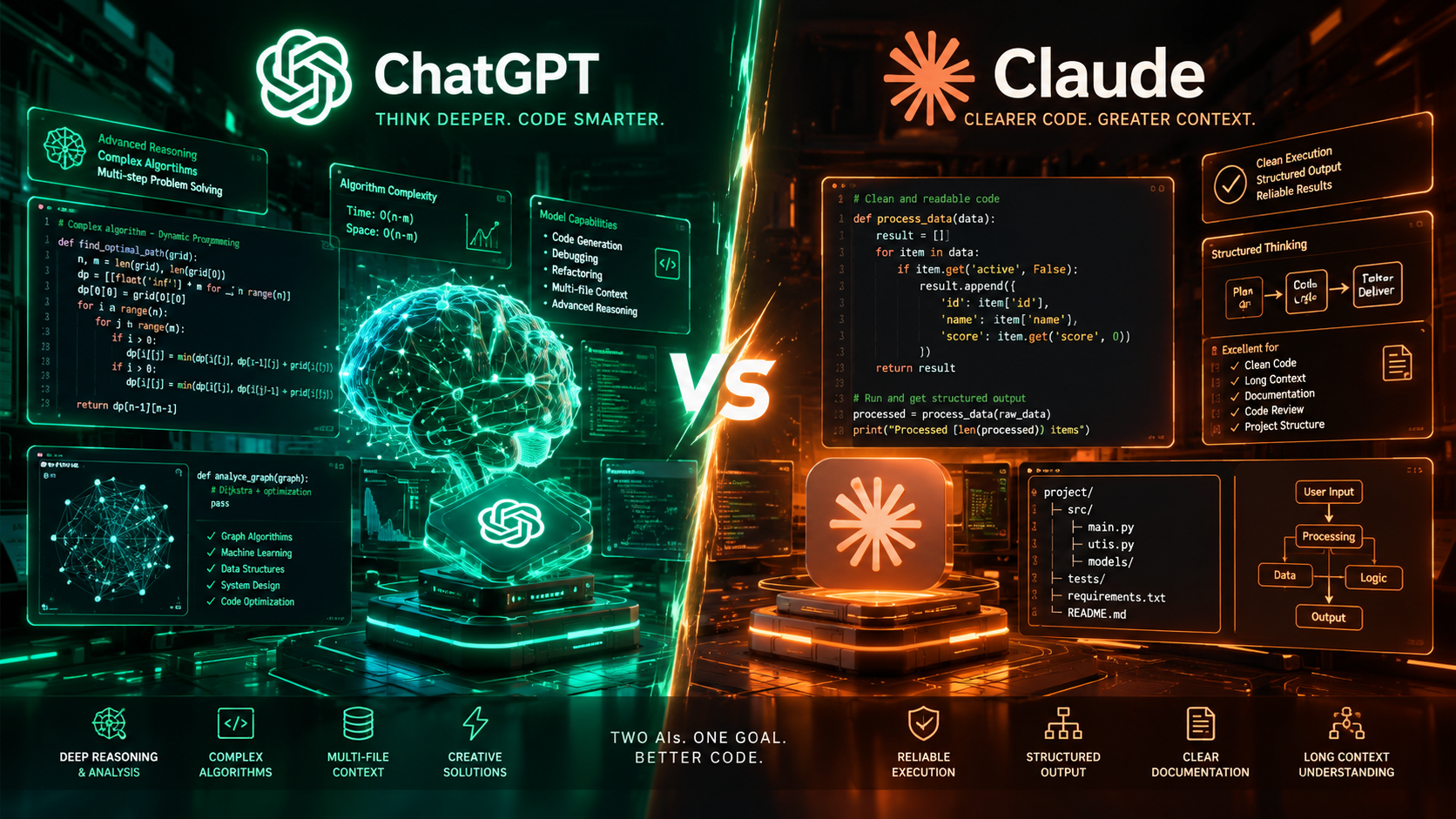
But they take somewhat different approaches.
ChatGPT combines OpenAI’s current coding models with Codex, an agentic coding environment designed for implementation, refactoring, debugging, testing, and validation. Claude Sonnet 5 is also built for sustained coding, tool use, debugging, and longer-running software engineering tasks.
So which one should you use?
The answer depends less on finding a single “best AI” and more on the type of development work you do.
Quick Answer:
- ChatGPT is a strong fit if you want coding alongside research, documentation, data analysis, multimodal work, and agentic development through Codex.
- Claude Sonnet 5 is worth considering if your workflow centers on sustained coding, repository exploration, debugging, and multi-step software engineering.
- Using both can make sense when you want a second perspective on architecture, debugging, or code reviews.
ChatGPT vs Claude Sonnet 5 for Coding: Quick Comparison
| Feature | ChatGPT / OpenAI | Claude Sonnet 5 |
| Coding | Strong coding and agentic development through current OpenAI models and Codex | Strong coding and agentic software engineering |
| Agentic Workflows | Codex supports implementation, refactoring, testing, debugging, and longer-running tasks | Designed for sustained planning, tool use, coding, and debugging |
| Debugging | Strong reasoning, tool use, testing, and iterative debugging | Strong focus on debugging and sustained technical tasks |
| Multi-File Work | Repository-level engineering through Codex | Designed for complex, multi-step software engineering |
| General-Purpose Work | Coding plus research, documents, spreadsheets, and multimodal tasks | Strong coding and broader knowledge-work capabilities |
| Context | Depends on the specific model and product | Depends on the specific model and Claude product |
| Best Fit | Developers who want coding plus a broad AI workspace | Developers focused heavily on coding and agentic workflows |
*Capabilities, limits, and availability can change as OpenAI and Anthropic release new models and product updates.
How We Compare ChatGPT and Claude Sonnet 5 for Coding
AI coding performance is difficult to summarize with a single benchmark score. A model can perform well on a coding benchmark but behave differently when working inside a real repository with unfamiliar dependencies, incomplete documentation, or ambiguous requirements.
For that reason, a useful comparison should consider several dimensions:
- Generating new code
- Understanding an existing codebase
- Debugging
- Multi-file refactoring
- Test generation and validation
- Tool use
- Long-running agentic tasks
- Explaining technical decisions
- Handling ambiguous requirements
This comparison focuses on practical developer workflows rather than treating one benchmark as a complete measure of coding ability.
Core Feature Comparison
1. Code Generation and System Architecture
Both ChatGPT and Claude Sonnet 5 can turn natural-language requirements into working code. The more interesting difference is how they fit into a larger development workflow.
ChatGPT
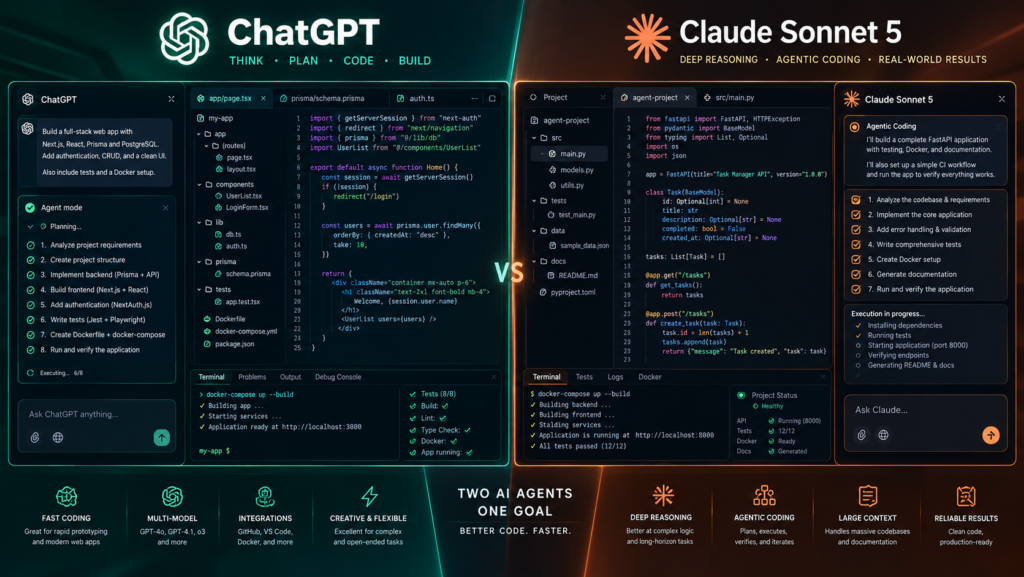
OpenAI’s current coding ecosystem combines its latest models with Codex, an agentic coding environment designed for tasks such as feature development, complex refactoring, migrations, testing, debugging, and validation. OpenAI describes GPT-5.5 as its strongest agentic coding model to date and reports improvements in long-running coding workflows.
This makes ChatGPT useful when you want one AI workspace for coding and broader tasks such as research, documentation, data analysis, and working with different types of files.
Claude Sonnet 5
Anthropic describes Sonnet 5 as its most agentic Sonnet model, with the ability to make plans, use tools such as browsers and terminals, and work autonomously on complex tasks. Anthropic highlights improvements in coding, reasoning, tool use, and knowledge work.
For developers, this makes Sonnet 5 particularly relevant to repository-level work rather than simple code snippets.
2. Debugging and Error Analysis
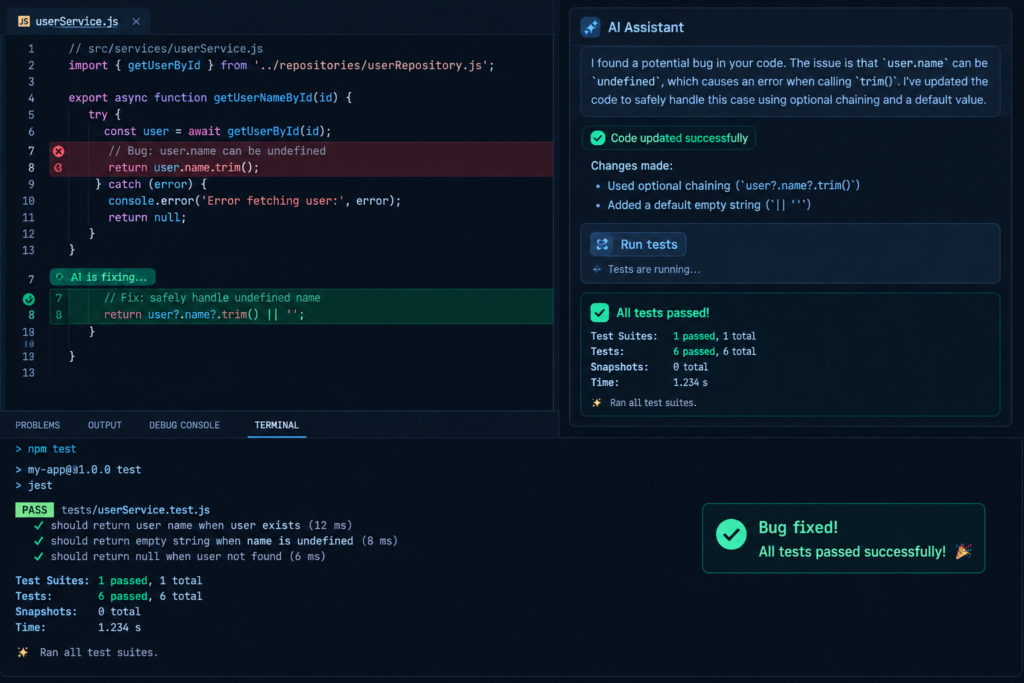
Debugging is where the difference between “generate code” and “understand a system” becomes especially important.
ChatGPT
OpenAI describes GPT-5.5 as capable of handling coding tasks involving planning, tool use, debugging, testing, and validation. Its coding capabilities are particularly integrated into Codex, where the model can work through engineering tasks and the surrounding codebase.
A practical workflow might look like this:
- Give the agent the failing project.
- Ask it to reproduce the problem.
- Inspect the relevant files and logs.
- Identify the likely root cause.
- Apply a fix.
- Run tests.
- Check for regressions.
Claude Sonnet 5
Anthropic similarly positions Sonnet 5 for sustained coding and debugging work. Its launch materials emphasize agentic performance, tool use, and the ability to continue through complex technical tasks.
For developers, the important question is therefore not simply which model can “fix a bug,” but which workflow produces a reliable result for the particular repository.
3. Refactoring Existing Codebases
Refactoring is more demanding than generating a new function. An AI coding assistant needs to understand dependencies, interfaces, tests, naming conventions, and the parts of the system that could be affected by a change.
ChatGPT and Codex
Codex is designed for repository-level engineering tasks, including implementation, refactoring, debugging, testing, and validation. OpenAI also describes it as useful for larger software-engineering workflows that require the model to work across the surrounding codebase.
Typical tasks include:
- Migrating an API
- Updating a framework
- Refactoring shared components
- Modifying multiple related files
- Generating and running tests
- Reviewing code changes
Claude Sonnet 5
Sonnet 5 is also designed for multi-step software engineering and sustained tool use. Anthropic specifically highlights coding, reasoning, and agentic workflows as areas of improvement over previous Sonnet models.
Note: For either model, developers should review changes carefully before merging them into production code. AI-generated refactoring can introduce subtle changes even when the application appears to work correctly.
4. Context and Large Codebases
Context-window size matters, but raw token capacity is not the only factor developers should consider. Other important factors include:
- How accurately the model retrieves relevant files
- How well it tracks dependencies
- Whether it maintains requirements across multiple turns
- How effectively it uses development tools
- Whether it can verify its own changes
- How much irrelevant context is included
OpenAI’s GPT-5.4 supports up to 1 million tokens of context in supported API use cases, while context limits can differ across OpenAI models and products. Developers should therefore check the specific model and environment they are using rather than treating “ChatGPT” as one fixed context window.
Claude Sonnet 5 also supports large-context workflows, but the practical limits depend on the specific Claude product and configuration.
The practical takeaway: Compare the exact model, product, and workflow you plan to use—not just the headline context-window number.
5. Agentic Coding Workflows
One of the biggest changes in AI-assisted software development is the move from code generation toward agentic coding. Modern coding models can do more than answer: “How do I write this function?”
They can increasingly work through a process like:
$$\text{Understand Repository} \longrightarrow \text{Plan Change} \longrightarrow \text{Edit Files} \longrightarrow \text{Run Tests} \longrightarrow \text{Investigate Failures} \longrightarrow \text{Refine Implementation}$$
ChatGPT + Codex
Codex is designed around this type of agentic workflow. OpenAI describes it as an environment for implementation, refactoring, debugging, testing, and validation. GPT-5.5 is also described as OpenAI’s strongest agentic coding model to date.
Claude Sonnet 5
Anthropic describes Sonnet 5 as its most agentic Sonnet model, highlighting planning, browser and terminal use, coding, and sustained technical work.
The broader shift is clear: AI coding assistants are increasingly designed to participate in software-engineering workflows rather than simply generate isolated snippets.
Real-World Developer Scenarios
Scenario A: Migrating Authentication Across a Large Project
Suppose you need to migrate a project from session-based authentication to JWT across dozens of files. A capable coding agent needs to:
- Locate authentication-related files.
- Understand the current architecture.
- Identify dependencies.
- Plan the migration.
- Update the implementation.
- Modify tests.
- Run the test suite.
- Fix resulting issues.
- Check for regressions.
Both ChatGPT/Codex and Claude Sonnet 5 are designed for this type of multi-step workflow. The actual result will depend heavily on the repository, instructions, available tools, model configuration, and test coverage.
Scenario B: Debugging a Race Condition in Node.js
Race conditions can be difficult because the bug may depend on timing rather than a single incorrect line. A useful AI workflow involves:
- Tracing asynchronous operations
- Inspecting promise handling
- Checking shared state
- Reproducing the failure
- Adding or reviewing tests
- Verifying the fix
Claude Sonnet 5 and OpenAI’s current coding models are both positioned for complex debugging and tool-assisted development. Rather than assuming one model will always find the answer, developers should evaluate both on the technology stack and repositories they actually use.
Coding Benchmarks: What Do They Actually Tell You?
Benchmarks can provide useful evidence, but they should not be treated as a complete substitute for real-world testing.
OpenAI reports GPT-5.5 at 58.6% on SWE-Bench Pro and 82.7% on Terminal-Bench 2.0. OpenAI describes SWE-Bench Pro as an evaluation of real-world GitHub issue resolution and Terminal-Bench 2.0 as an evaluation of complex command-line workflows involving planning, iteration, and tool coordination.
Anthropic publishes its own evaluation results for Sonnet 5, including comparisons with previous Sonnet and Opus models across agentic and coding-related evaluations.
These results are useful reference points, but the companies’ own published evaluations should be interpreted within their respective methodologies. They are not a substitute for testing an AI assistant on your own codebase.
A Practical Evaluation Strategy
For a developer choosing between AI coding tools, consider three types of evidence:
$$\text{Published Benchmarks} + \text{Hands-On Testing} + \text{Your Own Repository Requirements}$$
That combination is more useful than relying on a single benchmark number.
Pricing and Value
AI pricing changes frequently, so developers should check the official pricing pages before purchasing.
Anthropic currently lists Claude Sonnet 5 at $2 per million input tokens and $10 per million output tokens. Anthropic made this introductory pricing permanent in August 2026.
OpenAI pricing varies by model, product, and usage mode. API access and ChatGPT/Codex access should therefore be evaluated separately rather than treated as one pricing structure.
For developers, the cheapest model per token is not necessarily the cheapest workflow. A model that completes a task with fewer retries, fewer tool calls, or less manual correction can have a lower effective cost even when its listed token price is higher.
ChatGPT vs Claude Sonnet 5: Pros and Cons
ChatGPT Pros
- Strong coding and reasoning capabilities
- Codex provides an agentic coding workflow
- Broad range of non-coding capabilities
- Useful for research, documentation, data analysis, and multimodal tasks
- Suitable for developers who want coding and general-purpose AI in one ecosystem
ChatGPT Cons
- The experience varies depending on the selected model and product
- Advanced coding workflows may have different usage limits or access levels
- Developers need to understand the differences between ChatGPT, Codex, and API usage
Claude Sonnet 5 Pros
- Strong focus on coding and agentic software engineering
- Designed for sustained tool use
- Relevant to repository-level development
- Strong fit for debugging and multi-step technical tasks
- API pricing of $2 per million input tokens and $10 per million output tokens
Claude Sonnet 5 Cons
- The workflow depends on the Claude product and coding environment
- Context and usage limits can vary by product and plan
- Developers looking for a broader general-purpose AI workspace may prefer a different setup
Which AI Coding Assistant Should You Use?
Who Should Use ChatGPT for Coding?
When deciding between ChatGPT vs Claude Sonnet 5 for coding, your choice should align directly with your daily development workflow and toolchain. ChatGPT is a strong option if you want your AI assistant to handle more than code. It can fit developers who regularly move between:
- Coding and debugging
- Research and documentation
- Data analysis
- Multimodal tasks
- Agentic development through Codex
Codex is particularly relevant if you want an AI agent to work through larger engineering tasks rather than simply provide code snippets.
Who Should Use Claude Sonnet 5 for Coding?
Claude Sonnet 5 is worth considering if your primary workflow revolves around:
- Software engineering
- Large repositories
- Multi-step coding tasks
- Complex debugging
- Terminal-based workflows
- Agentic development
Anthropic specifically designed Sonnet 5 to improve sustained agentic work, coding, tool use, and knowledge work.
Should Developers Use ChatGPT and Claude Together?
Yes. Developers do not necessarily need to use one AI assistant for every stage of software development. One practical workflow is to use:
- Model A: Generate an initial implementation, explore an unfamiliar API, or scaffold a feature.
- Model B: Review the implementation, identify edge cases, inspect a difficult bug, or provide architectural feedback.
The key is to treat the second model as another source of analysis—not as automatic proof that the first model’s code is correct. Automated tests, version control, code review, and human judgment remain important.
Frequently Asked Questions
Is Claude Sonnet 5 better than ChatGPT for coding?
There is no single answer that applies to every coding task. Both platforms offer strong coding and agentic capabilities. ChatGPT combines OpenAI’s coding models with Codex and a broader AI workspace, while Claude Sonnet 5 focuses heavily on sustained coding, tool use, and software-engineering workflows. The practical choice depends on your programming language, repository, tools, workflow, and budget.
Is ChatGPT good for large codebases?
Yes. OpenAI’s Codex is designed for repository-level engineering tasks, including implementation, refactoring, debugging, testing, and validation. Developers should still review changes and run automated tests before deploying AI-generated modifications.
Is Claude Sonnet 5 good for debugging?
Yes. Anthropic specifically positions Sonnet 5 for coding, reasoning, tool use, and sustained technical work. As with any AI coding assistant, the reliability of a debugging result depends on the available context, tools, tests, and quality of the instructions.
Which option wins in ChatGPT vs Claude Sonnet 5 for coding in 2026?
Both offer capable coding and agentic workflows, but their products emphasize somewhat different experiences. ChatGPT combines coding with a broader AI workspace and Codex-based agentic development. Claude Sonnet 5 focuses heavily on sustained agentic coding and software engineering. The most useful comparison is therefore task-specific rather than a single overall ranking.
Can ChatGPT and Claude be used together?
Yes. Developers can use multiple AI assistants for different stages of the software-development lifecycle, including implementation, debugging, code review, documentation, and architecture discussions.
Does context-window size matter for coding?
Yes, but context size is only one factor. Retrieval accuracy, tool use, reasoning, repository structure, test coverage, and the ability to maintain requirements across long tasks can all affect the final result.
Which is cheaper for coding?
It depends on whether you are comparing consumer subscriptions, API usage, or agentic coding products. Claude Sonnet 5’s current API price is $2 per million input tokens and $10 per million output tokens. OpenAI pricing varies by model and product. Check the current official pricing pages before making a purchasing decision.
Final Thoughts
Comparing ChatGPT vs Claude Sonnet 5 for coding highlights two distinct yet highly capable approaches to modern software engineering in 2026.
The more useful question is not simply “Which AI is best?” Instead, look at how each tool performs on the work you actually need to do:
- Does it understand your existing codebase?
- Can it plan a multi-step change?
- Can it use development tools effectively?
- Can it test its own work?
- Can it recover when something fails?
- Can it maintain context throughout a long engineering task?
- Does its pricing fit your workflow?
ChatGPT, particularly through GPT-5.5 and Codex, is designed around coding, reasoning, tool use, and longer-running agentic workflows. Claude Sonnet 5 is likewise designed for sustained coding, tool use, debugging, and complex software-engineering tasks.
For developers, the most reliable approach is to evaluate both against the technology stack, repository, and development workflow that matter to them.
Last updated: September 19, 2026
Sources
- OpenAI — GPT-5.5
- OpenAI — Codex
- Anthropic — Claude Sonnet 5
- Google Search Central — Creating Helpful, Reliable, People-First Content
- Google Search Central — Generative AI Search guidance